Thermal Analysis: Galaxy Z Fold 8 Ultra vs. Galaxy S26 Ultra — Does the Lack of Active Cooling Matter?
We used a thermal camera to compare the Galaxy Z Fold 8 Ultra against the Galaxy S26 Ultra. Discover how the lack of a vapor chamber affects heat distribution.
The Battle of Thermal Management: Foldables vs. Slabs
Samsung's latest flagship lineup brings an incredible array of hardware upgrades, most notably the powerhouse Snapdragon 8 Elite Gen 5 for Galaxy chip. However, a critical disparity exists between the Galaxy S26 Ultra and the Galaxy Z Fold 8 Ultra: the cooling system. While the S26 Ultra utilizes a sophisticated vapor chamber to dissipate heat, the Z Fold 8 Ultra relies on passive cooling. To determine if this absence impacts real-world performance and longevity, we put both devices—along with the iPhone 17 Pro Max and the Galaxy Z Fold 7—through a rigorous thermal stress test using the Flir One Pro thermal camera.
The Closed-State Challenge: Initial Heat Distribution
Using 3DMark's Solar Bay Extreme Stress Test, we monitored the surface temperatures of the devices while they remained closed. The results were immediate and telling. The Galaxy S26 Ultra warmed up the fastest, hitting approximately 30°C (86°F) within the first minute. The iPhone 17 Pro Max followed a similar trajectory, with heat concentrating heavily around its raised camera plateau—a design choice Apple specifically implemented to aid heat dissipation.
Interestingly, the Galaxy Z Fold 8 Ultra and its predecessor, the Z Fold 7, showed a much slower rise in temperature while folded. By the 4-minute mark, the S26 Ultra was approaching 40°C (104°F), while the foldables were only just crossing the 30°C threshold. However, this wasn't necessarily a sign of superior cooling, but rather a result of where the heat was trapped.
Unfolding the Truth: The Thermal Bloom
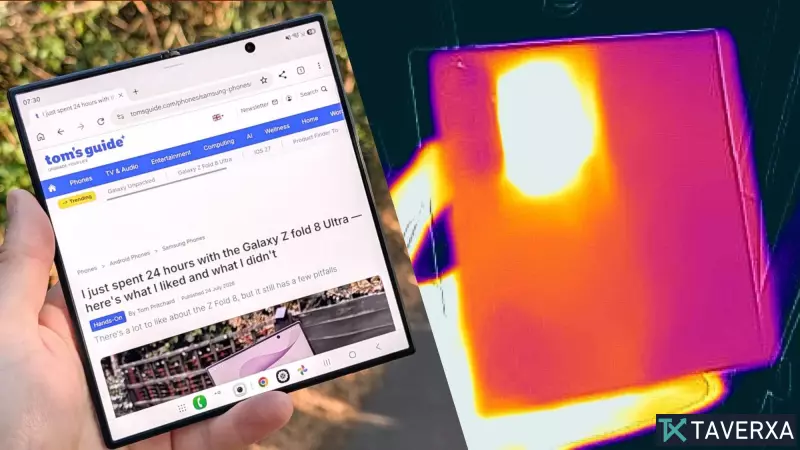
The real revelation occurred when the Z Fold 8 Ultra was unfolded. The thermal imagery shifted dramatically. Almost instantly, heat bloomed from the top right corner near the camera assembly. Within just 60 seconds, the Z Fold 8 Ultra surged past 40°C (104°F), surpassing the S26 Ultra's surface temperature.
Our analysis revealed a significant bottleneck: the hinge. Thermal data suggests that heat struggles to bypass the folding mechanism, causing it to pool on the right side of the device. While the S26 Ultra's vapor chamber actively routes heat away from the core chipset and battery toward the top-left edge (away from the cameras), the Z Fold 8 Ultra lacks this active routing. Instead, heat spreads organically across the chassis until it radiates away from the edges.
The Verdict: Performance and Longevity Risks
While both the S26 Ultra and Z Fold 8 Ultra reached similar peak temperatures during the stress test, the method of heat distribution is what matters. In the S26 Ultra, the vapor chamber siphons heat away from sensitive internal components. In the Z Fold 8 Ultra, the heat lingers closer to the core hardware for longer periods.
Over short bursts of high-performance activity, the Z Fold 8 Ultra performs admirably, as it cools down rapidly once the load is removed. However, for power users engaging in extended gaming or heavy multitasking, this lack of active cooling could lead to thermal throttling—where the phone slows down the processor to prevent overheating—and may potentially reduce the long-term lifespan of the battery and chipset due to repeated heat saturation.
Pro Tips for Keeping Your Foldable Cool
To maximize the lifespan of your Galaxy Z Fold 8 Ultra, consider the following measures during heavy use:
- Avoid Direct Sunlight: External heat compounds the internal thermal struggle.
- Pause Charging: Charging generates its own heat; avoid doing it while running demanding apps.
- Use External Cooling: Small phone coolers or fans can significantly help dissipate surface heat.
- Avoid Extreme Cooling: Never put your phone in a fridge or freezer, as rapid temperature shifts can cause internal condensation and permanent damage.