The Foldable Dilemma: Why the Galaxy Z Fold 8 Proves Apple's Software Strategy is the Ultimate Weapon
Testing the Galaxy Z Fold 8 reveals a critical flaw in foldable software. Discover why Apple's upcoming foldable could dominate by solving app scaling and layout adaptation.
The State of the Foldable Market
After rigorous testing of the Samsung Galaxy Z Fold 8 and the high-performance Z Fold 8 Ultra, it is clear that Samsung remains the undisputed leader in foldable hardware. From the refined, thinner chassis to the nearly invisible display crease, the engineering is a testament to Samsung's maturity in the sector. However, the wider aspect ratio of the standard Z Fold 8 proves that the industry is still experimenting with the ideal form factor to balance phone-like utility with tablet-like productivity.
Despite these hardware triumphs, a persistent ghost haunts the foldable experience: app scaling and dynamic layout adaptation. While Google and Samsung have pushed the boundaries of multitasking, the software often fails to keep pace with the hardware's versatility.
The 'Software First' Philosophy
To understand where Apple might win, one only needs to look back to 2007. When Steve Jobs introduced the original iPhone, it was objectively inferior in hardware specs to many rivals. It lacked 3G and physical keyboards, yet it revolutionized the world because Apple prioritized the user experience. Fluid gestures, kinetic scrolling, and a desktop-class browser redefined the category.
This historical precedent suggests that for the rumored 'iPhone Ultra' foldable, Apple doesn't need to win the 'spec war' or even achieve a perfectly flat screen. Instead, the opportunity lies in delivering a class-defining software experience that makes the transition from a phone to a tablet feel invisible.
The Current Pain Points of Android Foldables
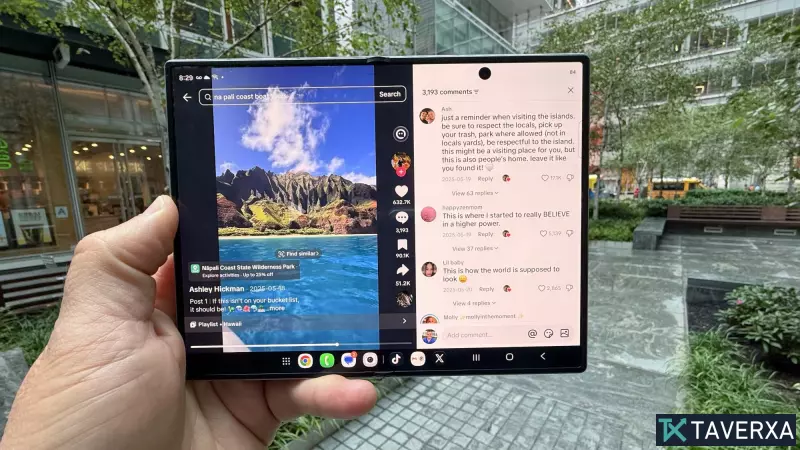
The Galaxy Z Fold 8 is a multitasking powerhouse, capable of running three apps simultaneously. Yet, this power is often undercut by poor app optimization. A common issue is 'letterboxing,' where apps like TikTok display large black bars on the inner screen rather than adapting their layout.
Gaming presents further challenges; titles like Age of Origins frequently appear stretched or require a full application restart to recognize the change in screen dimensions. While native Google apps like Gmail and YouTube transition seamlessly, the vast majority of third-party applications still treat the unfolded screen as a stretched-out smartphone rather than a compact tablet.
How Apple Could Redefine the Foldable Experience
The path to victory for an Apple foldable lies in 'Seamless Scaling.' Rather than simply blowing up a phone app to fill a larger screen, Apple can leverage its existing iPadOS expertise to enforce multi-column, adaptive layouts across its entire ecosystem.
An ideal iPhone Ultra experience would feature:
- Dynamic Layouts: Apps that transform instantly from a single-column mobile view to a multi-column tablet view without refreshing.
- Memory Persistence: The ability to switch orientations without the system clearing the app from memory to adjust the UI.
- Ecosystem Enforcement: Utilizing strict App Store guidelines to ensure all developers optimize for the folding form factor, similar to how Apple handled the transition to larger iPhone screens and iPads.
If Apple can bridge the gap between the iPhone and iPad experiences in a single, folding device, they won't just enter the foldable market—they will solve the one thing that currently makes foldables feel like beta products.