A Blueprint for Conflict: Why the Lebanon-Israel Framework Agreement May Be a Strategic Trap
Analysis of the Lebanon-Israel framework agreement and why it may act as a strategic trap, paving the way for future conflict and compromising Lebanese sovereignty.
A Fragile Peace or a Tactical Prelude?
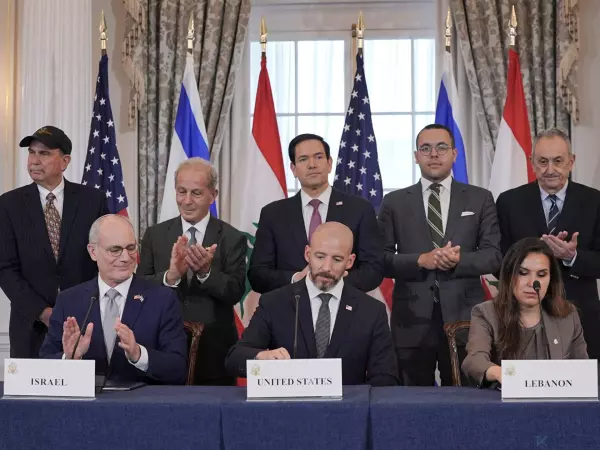
After months of grueling military conflict, intense diplomatic pressure, and carefully choreographed negotiations, Lebanon and Israel have entered into a framework agreement—a 'declaration of intent'—signed at the U.S. State Department in Washington. While the international community may view the signing by Ambassador Nada Hamadeh of Lebanon and Ambassador Yechiel Leiter of Israel as a step toward de-escalation, a deeper analysis suggests a more ominous outcome. Rather than securing a lasting peace, the agreement may be paving the road toward the next inevitable war, while strategically ensuring that Lebanon bears the burden of blame.
The 'Oslo Logic': The Danger of Ambiguity
The current agreement mirrors a diplomatic strategy Israel has employed for decades: the use of loosely worded interim arrangements and deferred questions. Critics point to the Oslo Accords as a primary example, where 'general guidelines' were established while critical issues like borders, sovereignty, and refugees were pushed to a 'later' that never arrived. This architecture allowed Israel to maintain freedom of action and expand territorial control while accusing the opposing party of failing to meet impossible conditions.
In the Lebanese context, this 'diplomatic logic' is alarming. By declaring an 'ambition to end conflict' without providing concrete, final answers, the framework creates a vacuum. Lebanon is essentially agreeing to a set of expectations that are nearly impossible to fulfill, given the internal complexities of its own governance and security apparatus.
The Impossible Mandate: State Sovereignty vs. Armed Actors
The central flaw of the agreement lies in its assumption that the Lebanese state can dismantle Hezbollah’s military infrastructure by simple decree. Hezbollah’s arsenal is not merely a military reality; it is deeply embedded in a socio-political narrative of deterrence and community protection, born from the perceived failure of the state to defend its territory.
Furthermore, the Lebanese Armed Forces (LAF) are expected to suddenly transform into a sovereign deterrent force. However, the LAF remains underfunded, overburdened, and heavily dependent on external military aid—aid that is often restricted by the very Israeli and American 'red lines' the agreement seeks to navigate. Lebanon is being asked to exercise state sovereignty in the exact areas where its capacity is weakest: controlling non-state armed actors it cannot defeat and negotiating with an adversary it cannot deter.
Constitutional Crisis and Legal Disarmament
Beyond the military implications, the agreement presents significant constitutional and legal challenges. Reports suggest that the document contains clauses requiring parties to cease 'hostile' or 'adverse' actions in international legal forums. For a state like Lebanon, which cannot match Israel's military might, international courts and diplomatic forums are its only remaining tools for accountability. Restricting these tools in the name of 'de-escalation' effectively disarms Lebanon in the only arena where it possesses leverage.
From a domestic legal standpoint, the agreement is constitutionally suspect. In Lebanon, treaties and international accords affecting national security and territorial integrity require institutional approval and cabinet consent. By framing this as a 'declaration of intent,' the current administration may be attempting to bypass constitutional safeguards, leading to fierce opposition from political factions like the Amal Movement and Hezbollah, who may view the move as a step toward normalization.
The Regional Chessboard: Who Really Holds the Pen?
The reality is that the fate of this agreement is not being decided in Beirut or Jerusalem, but through a wider regional track involving the United States, Iran, and various mediators. The true 'deal' depends on instructions from Tehran to Hezbollah and guarantees from Washington. The current document may simply be a tactical tool to satisfy U.S. political optics—specifically for President Donald Trump—providing a few months of breathing room before the next cycle of regional escalation.
Conclusion: The Justification for Future War
The tragedy of this framework is that it creates a legal and political scorecard that Lebanon is destined to fail. If Hezbollah refuses to disarm, Israel can claim Lebanon violated the agreement. If the LAF cannot secure the border, Israel can cite Lebanese failure. If Beirut seeks justice in international courts, Israel can allege bad faith.
Ultimately, the agreement does not prevent the next war; it provides the linguistic and legal justification for it. Instead of building a foundation for real sovereignty—characterized by a capable army and internal political consent—Lebanon has entered a framework that exposes its vulnerability and prepares the ground for future conflict.