Samsung's New 'Flex Titanium' Display: The End of the Foldable Crease?
Samsung's new Flex Titanium technology in the Galaxy Z Fold 8 aims to eliminate the foldable screen crease and drastically increase durability. Read more about the breakthrough.
A New Era for Foldable Screens
For years, the most significant hurdle in the adoption of foldable smartphones has been the 'crease'—that visible, tactile dip where the screen bends. While Samsung has led the market since 2019, the crease has remained a persistent point of criticism. However, a recent deep dive into Samsung Display's headquarters in South Korea reveals a breakthrough that could finally solve this problem: Flex Titanium.
Unveiled ahead of the upcoming Galaxy Z Fold 8 launch, Flex Titanium is not just a marketing term but a fundamental shift in material science. By integrating a titanium-alloy film and a flexible titanium plate, Samsung claims to have nearly erased the crease while simultaneously increasing durability and reducing the overall thickness of the panel.
Understanding the Science: What is Flex Titanium?
Unlike previous iterations where titanium was primarily used for the outer frame to enhance toughness, Flex Titanium is integrated directly into the display stack. The technology consists of two primary components:
- Titanium-Alloy Film: This ultra-thin layer sits beneath the OLED panel. Despite being only 30% the thickness of a human hair, it provides 20 times more stiffness than traditional plastic films. This allows the screen to maintain its structural integrity without adding bulk.
- Flexible Titanium Plate: A supportive structure that sits beneath the entire display module. By using a precision laser-hole process and a lattice structure, Samsung has eliminated air gaps between the module and the adhesive, resulting in a tighter bond and a significantly smoother surface.
According to Byung Duk Yang, Executive VP of the Core Component Technology Team, the key was developing a titanium alloy that offers 'stretchability,' overcoming the natural rigidity of the metal to allow for a seamless fold.
Torture Testing: 500,000 Folds and Metal Ball Drops
To prove the resilience of the Flex Titanium display, Samsung employs rigorous testing protocols that go far beyond standard consumer use. In the heart of their labs, robotic arms continuously fold and unfold devices 24 hours a day.
The benchmarks are staggering: at room temperature, the displays are tested up to 500,000 folds. Samsung also accounts for extreme environments, testing the panels in sealed chambers ranging from 140°F (60°C) down to -4°F (-20°C). Even under these extreme thermal stresses, the panels maintained their functionality, folding up to 300,000 times at peak heat.
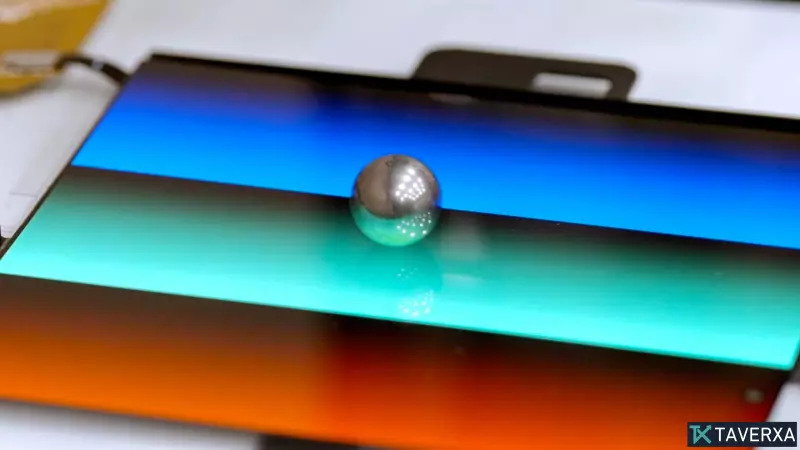
Durability isn't just about folding; it's about impact. Samsung demonstrated the strength of the new panel by dropping 21.7-gram metal balls from heights of up to 50cm. The result? Not a single scratch on the display, suggesting that the Flex Titanium layer provides a level of protection previously unseen in foldable devices.
The Competitive Landscape: A Warning to Apple
The timing of this innovation is strategic. With rumors swirling about Apple's imminent entry into the market with a potential 'iPhone Ultra' or 'iPhone Fold,' Samsung is widening its moat. For Apple, the challenge has always been to wait until a technology is 'perfect' before launching. By solving the crease and durability issues, Samsung is removing the primary reasons consumers hesitate to switch to foldables.
KyungJin Yoo, EVP and Head of Mobile Display Product Development, views Apple's entry not as a threat, but as validation. 'When other competitors and companies join the market, I think the market will expand and the awareness will increase,' Yoo noted, emphasizing that Samsung's years of iterative experience give them a critical advantage in refining the hardware.
Final Verdict: Mainstream Adoption is Near
Samsung has been playing the long game with foldable tech since 2009. While the first Galaxy Fold was a proof-of-concept plagued by fragility, the Galaxy Z Fold 8 looks to be the culmination of that journey. If Flex Titanium delivers on its promise of a crease-free, ultra-durable, and thin experience, the foldable phone may finally move from a niche enthusiast gadget to a mainstream powerhouse.