EU Escalates Response to Russian Cyber-Espionage with New Sanctions Amid Ukraine Security Summit
The EU has sanctioned nine individuals and four entities over a years-long Russian cyber-espionage campaign targeting nine European countries.
European Union Targets Russian Cyber-Warfare Network
The European Union has significantly intensified its diplomatic and economic pressure on the Kremlin, announcing a fresh wave of sanctions targeting nine individuals and four entities. These measures come in response to what the bloc describes as a pervasive, years-long cyber-espionage campaign designed to destabilize the EU, its member states, and various international partners.
In a stern statement released by the European Council, officials emphasized that the targeted individuals—comprising Russian military officers, specialized hackers, and private firms—have been instrumental in executing sophisticated digital attacks. The scope of these operations is vast, with confirmed targets spanning at least nine European nations, including France, Germany, Poland, Cyprus, the Netherlands, Austria, Slovakia, Romania, and Finland.
Diplomatic Fallout and German Reaction
The revelation of these cyber-attacks has triggered immediate diplomatic repercussions. Germany's Federal Foreign Office took a decisive stance, summoning the Russian ambassador to the Ministry to deliver a formal reprimand. A ministry spokeswoman characterized the hostile cyber activities as "unacceptable," asserting that such aggression would be met with a resolute and decisive response from Berlin.
This move highlights a growing trend among EU member states to shift from passive defense to active deterrence as Russia continues to utilize hybrid warfare—combining traditional military aggression with digital sabotage—to exert influence over European security.
The 'Coalition of the Willing' and the Paris Summit
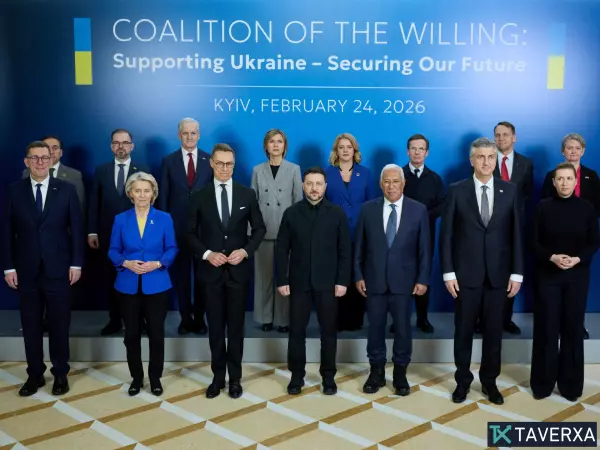
Simultaneous to the sanctions, the geopolitical landscape is shifting toward a critical summit in Paris. Ukrainian President Volodymyr Zelenskyy is set to meet with 25 state leaders as part of the "Coalition of the Willing." The primary goal of this gathering is to establish concrete security guarantees and air-defense commitments for Ukraine, particularly as US-brokered negotiations with Russia remain stalled.
French President Emmanuel Macron is expected to play a pivotal role in these discussions. Prior to the main summit, leaders from nine nations—including Italy, Germany, Sweden, Denmark, and Norway—are scheduled to meet with top arms manufacturers such as Leonardo, Thales, Saab, and the SAMP-T producer Eurosam. Their objective is to rapidly scale up air-defense infrastructure to protect Ukrainian cities from relentless missile barrages.
Project FREYJA: A New Era of Air Defense
A centerpiece of the Paris agenda is the formalization of 'Project FREYJA.' This ambitious initiative aims to develop a European-backed, cost-effective alternative to the American Patriot missile system. With Ukraine facing a critical shortage of munitions and struggling to intercept high-speed ballistic missiles, the FREYJA project represents a strategic pivot toward European defense autonomy.
President Zelenskyy has urgently called for increased pressure on the aggressor, citing recent strikes on civilian sites in Odesa as proof that Russia remains committed to terrorizing non-combatants. "The pressure on Russia must work," Zelenskyy stated via X, advocating for more sanctions and the acceleration of the anti-ballistic project.
Kremlin Dismisses Western Efforts
As expected, the Kremlin has reacted with hostility to the EU's sanctions and the Paris summit. Spokesman Dmitry Peskov dismissed the "Coalition of the Willing" as a "coalition of warmongers," alleging that the participating nations are actively pursuing hostile actions against Russia. Peskov insisted that the Russian government would be monitoring the outcome of the Paris meetings very closely, framing the diplomatic efforts as an obstacle to peace rather than a path toward it.