Stitching Sorrow: Welsh Artist Memorializes Gaza's Lost Infants Through a Haunting Christening Gown
Welsh artist Diana Williams creates 'Know Their Names,' a haunting christening gown embroidered with the names of 300 infants killed in Gaza to highlight the war's human cost.
The Symbolism of Innocence and Loss
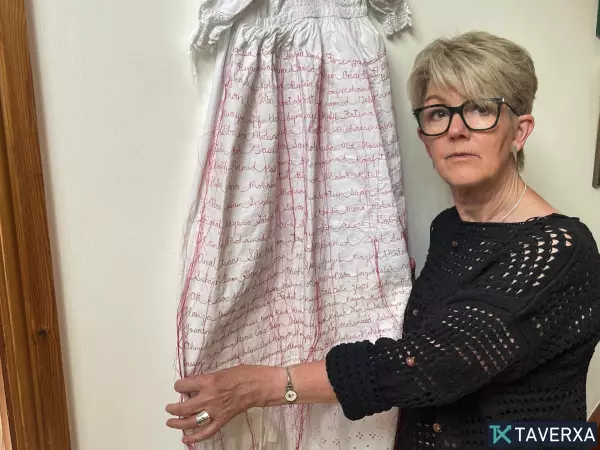
In the quiet corners of Wales, artist Diana Williams has created a visceral monument to the most vulnerable victims of the ongoing conflict in Gaza. Using a vintage christening gown—a garment traditionally symbolizing purity, new beginnings, and familial hope—Williams has transformed a symbol of life into a haunting memorial for those whose lives were cut short.
The artwork, titled "Know Their Names," is not merely a piece of fabric, but a meticulously crafted narrative of grief. Over the course of four months, the retired art lecturer spent countless hours embroidering the names of 300 infants, all under the age of one, who were killed during the Israeli military campaign in Gaza. Names like Sara, Elias, Mai, and Mona are stitched into the fabric in striking red thread, serving as permanent reminders of individual lives lost amidst staggering casualty statistics.
A Design of Desolation
Williams' approach to the piece is deeply intentional, utilizing the physical state of the gown to reflect the reality of war. To mirror the devastation and the precarious conditions faced by Palestinians, she intentionally frayed the hem of the dress using a harsh cleaning product, leaving the fabric torn and ragged.
The visual impact of the piece is designed to draw the viewer's eye downward. As the gown hangs, the frayed threads pool at the bottom, creating a visual metaphor for a pool of blood. "I wanted it torn and ragged to represent the conditions in which these people live under," Williams explained. "When it’s actually hanging, the threads drop the viewer to the bottom where you can sense the profound loss."
Driven by Moral Compulsion
For Williams, the project was born out of a necessity to act. As a mother of three and grandmother of two, she found the images of mourning parents in Gaza unbearable. She was particularly moved by reports regarding Gaza's Christian minority, where parents were reportedly rushing to baptize their infants in a desperate race against the fear of imminent death.
The artist expresses a profound frustration with global leadership, noting a disconnect between the empathy shown by ordinary citizens and the perceived indifference of politicians. "All these politicians are fathers, mothers, aunties, uncles," she remarked, questioning how such a tragedy is allowed to persist while those in power remain silent or inactive.
From Local Galleries to Global Stages
The emotional weight of "Know Their Names" has already garnered significant recognition. The piece won a people's award at Galeri Caernarfon in Wales, and Williams subsequently donated the prize money to Medical Aid for Palestinians (MAP). The gown has also been shortlisted for display at the National Eisteddfod, one of Wales' most prestigious cultural festivals.
However, Williams aims for a global reach to ensure the world does not look away. Plans are already in motion for the gown to be exhibited in Paris and to be featured on a massive billboard in New York City. By moving the artwork from a local gallery to the heart of international hubs, Williams hopes to spark a wider debate on the humanitarian crisis and the staggering loss of over 20,000 children in Gaza since October 2023.
Ultimately, the empty gown stands as a powerful testament to absence. By filling a garment meant for a living child with the names of the dead, Williams forces the viewer to confront the void left behind by war—a void that cannot be filled by politics, but only acknowledged through remembrance.